

Toast at a campsite sounds like a small thing until you’ve spent a week eating cold bread out of a bag. A folding stovetop toaster weighs almost nothing, costs little, and turns the same loaf into something that feels like breakfast at home.
It’s also one of the few camp kitchen items that confuses people the first time they unfold it. There’s no dial, no timer, no pop-up. You are the timer.
Here’s how these things work in practice, on a propane burner, an RV stovetop, or a grate over a fire.
Setting it up on the burner before you add bread
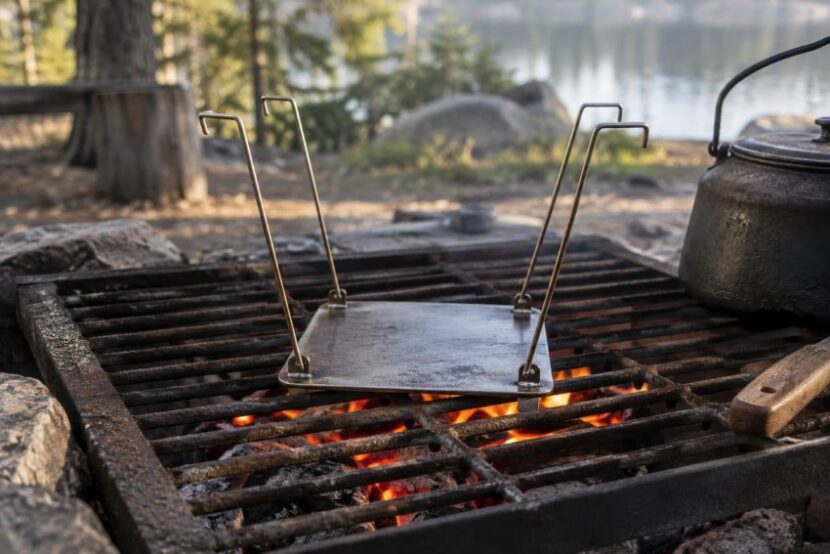
Unfold the toaster and set it on your burner or grate with nothing on it. Press down lightly on each corner. If it rocks, you’ll get one slice that’s nearly black and one that’s barely warm, so sort that out now rather than halfway through.
Camp stove grates vary wildly. Widely spaced wires are the usual culprit when a round base won’t sit flat, and the standard fix is low-tech: slide a coin or a thin shim under the high side until the base stops wobbling.

RV stoves deserve their own check. Propane elements in trailers and vans are often smaller than a home burner, and a toaster base that overhangs too far will throw heat up the outside of the frame instead of through it.
Once it sits level, the wire arms fold out and hold each slice at an angle, leaning in toward the center. That angle is deliberate. It keeps the bread close enough to catch rising heat without touching the flame directly.
Bread goes on, heat goes up
The instruction sheets that come with these toasters almost always say to start on low. Most people who use them regularly ignore that advice, and for good reason: low heat dries bread out long before it browns, leaving you with something closer to a cracker.
Medium to high is where stovetop toasting works. The bread should start to color within the first minute or so.
Figure on two to five minutes total for a batch, depending on your burner, your bread, and the wind. Thick-cut slices take longer. Day-old bread browns faster than fresh.

Stay near it. This is not a device you walk away from, and the single most common complaint about camp toast (burnt on one side, pale on the other) comes down to nobody watching.
Flip or rotate partway through. On wire-only designs, which rely on direct contact and rising heat, you’ll be doing this every time. On models with a perforated steel base or a dual-layer mesh that softens the flame into a gentler infrared heat, the browning is more forgiving and you can often get away with one turn.
Why a camping toaster’s design changes how you cook
A bare-wire toaster is the classic: four fold-out arms on a light steel base, flat-packing to nothing, the kind of thing that survives decades in a tote box. It demands attention. You flip, you rotate, you learn your burner’s hot spot.
Mesh and heat-diffuser models work differently. The mesh spreads flame into a broader, softer heat, which means fewer scorched stripes and better results when you’re toasting for four people who all want breakfast at once.
Neither is wrong, but the gap shows up fastest over an open fire, where a bare-wire frame passes the full intensity of the coals straight into the bread while a mesh base tempers it. That difference in base material is exactly what separates a toaster that works fine for one trip from one that holds up over years of camping, and it’s the detail most best camping toaster comparisons focus on before slice count or folding size.
Size matters too. Four-slice capacity is standard and speeds up group breakfasts in an RV, but it also eats more space in a pack. Solo backpackers often do better with a smaller or single-slice frame that collapses to a footprint around six inches square.
Toasting over a campfire without turning breakfast into charcoal
Open flame is faster and less predictable than a controlled burner. The rule is distance: set the toaster on a stable grill grate well above the coals rather than down in the flames.
Coals are your friend here. A bed of embers gives steadier heat than burning logs, which flare up without warning and will blacken a slice in under a minute.
Wind is the other variable. A partial barrier, even just positioning yourself and a cooler on the upwind side, keeps the heat consistent and stops a lightweight folding frame from tipping onto the grate.

Expect to stand over it the entire time. Fire toasting is quick enough that the difference between golden and ruined is maybe twenty seconds.
Bread isn’t the only thing that works
English muffins, bagel halves, and tortillas all toast well on these frames. Plenty of campers use them for small pieces of sausage, meat, or fish, which works fine as long as you accept that you’ll be cleaning grease off the wires afterward.
What doesn’t work: anything crumbly or small enough to slip between the wires and land in the burner. Mesh-based models handle those far better, since there’s a continuous surface underneath.
Watch for drips either way. A piece of food falling into an open flame on a windy day is the kind of minor event that gets exciting quickly.
Some of these toasters come with a detachable fork for lifting hot slices off. If yours doesn’t, keep tongs within reach, because the frame gets hot fast and the handle connection points aren’t always as cool as you’d hope.
Cleaning it and keeping rust off
Let the toaster cool completely before you touch it. Then wipe the crumbs away with a damp cloth, and work on anything stubborn with a soft brush rather than anything abrasive.
Drying is the step people skip, and it’s the one that matters. A toaster packed away damp in a trailer compartment or the bottom of a backpack will develop surface oxidation over a winter, even on steel marketed as rust-resistant.
Painted steel corrodes sooner than stainless. If you’re buying for a humid environment, 304-grade stainless is the material that holds up longest, resisting both rust and the heat damage that shows at the welds.
Speaking of welds: check them and the handle joints occasionally. That’s where a folding frame fails first, long before the toasting surface gives out.
Store it flat in a stuff sack or its original sleeve, somewhere cool and dry. If rust spots do appear, a little vinegar rubbed on and dried off usually takes care of them.
Who gets the most use out of one
The campers who use these most are the ones without reliable power: tent campers, van-lifers running a single propane burner, and RV travelers who’d rather not fire up a generator for breakfast. If you camp a few nights a year and don’t care much about toast, skip it. If you’re out for weeks at a time with a loaf of bread in the food bin, a flat-folding steel frame earns its space on about the third morning.